



The Indian Rupee recently touched a new low against the US Dollar, sparking fresh conversation around the state of India’s economy. In moments like these, investors and consumers often begin to worry: Will this lead to higher inflation? Will global investors lose confidence? Are our portfolios at risk? Such concerns are natural when headlines become dramatic. But currency movement cannot be understood through fear — it must be understood through fundamentals.
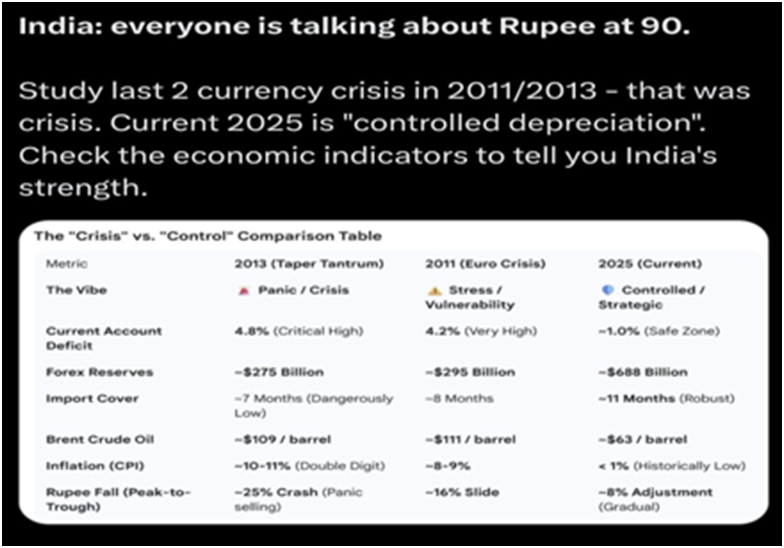
When we step back and compare today’s situation with the last major currency shocks India experienced in 2011 and 2013, the difference is not just notable — it is reassuring. The rupee’s weakness this time is occurring in a far stronger economic environment, where India holds higher resilience, greater global relevance and stronger buffers against volatility. In simple terms: What we are seeing in 2025 is a controlled depreciation — not a crisis.
Learning from the Past: Why 2025 Stands Apart
In 2011 and 2013, India struggled with a dangerous combination of high inflation, expensive crude oil, weak forex reserves and a high current account deficit. Confidence was low, foreign investors were exiting, and the rupee fell sharply in panic-driven trading. The situation was reactive, unplanned and damaging to growth.
Today’s picture looks very different. India’s forex reserves are now among the highest in the world — enabling us to manage imported inflation and maintain stable financial flows. Inflation is under control, the economy continues to expand at one of the fastest rates globally, and imports like crude oil are currently priced much lower than during past crises. This is not a market under pressure — this is a market navigating global realities with maturity and capability.
Even the rupee’s decline is more gradual, not a sudden panic slide. Markets understand that India’s fundamentals remain strong. International investors are not fleeing — India continues to be a preferred investment destination among global emerging markets.
Why the Rupee Has Moved — and Why It Isn’t a Red Flag
A key driver of current currency movements has little to do with India itself. The US Dollar is experiencing a period of unusual strength due to higher interest rates and global risk-off sentiment. When this happens, almost all world currencies tend to weaken against the Dollar — including those from strong economies like Japan, South Korea and the United Kingdom.
So, the rupee’s depreciation is less a reflection of India falling behind and more a reflection of a temporarily stronger US Dollar. Importantly, India is using this as a strategic adjustment to improve export competitiveness, support global trade positioning, and strengthen long-term manufacturing goals under initiatives such as Make in India.
What This Means for Investors: Opportunity Behind the Noise
Periods of currency softness are not a reason to rush out of markets — instead, they open avenues for strategic growth. Export-oriented sectors such as pharmaceuticals, IT services, chemicals and auto components often see improved realisations when the rupee is weaker. Companies generating income abroad benefit when earnings are converted back into rupees. Additionally, remittances from NRIs — one of the strongest support systems for India’s financial ecosystem — become more valuable domestically.
Equity markets may experience short-term fluctuations, but long-term investors can use such periods to accumulate high-quality businesses and strengthen their portfolio positioning. History has consistently shown one message: those who stay invested during volatility benefit most when stability returns.
India’s Long-Term Growth Story Remains Intact
India continues to build a future driven by strong consumption, infrastructure development, digital transformation and a powerful demographic advantage. The world views India not just as a market — but as a rising global force. Currency fluctuations do not change the reality of our economic trajectory.
A strong nation is not measured by a single day’s exchange rate. It is measured by its direction — and India’s direction remains upward.
The Ekaiva Perspective
At Ekaiva, we encourage clients to look beyond short-term movements and focus on fundamentals and opportunity. We believe this rupee phase should be viewed with stability, patience and strategy — not fear. In times like this, portfolio discipline matters the most:
- Prioritise quality investments with sound financials
- Maintain diversification across sectors and asset classes
- Align investment decisions with long-term goals, not headlines
A weak rupee today does not dim the promise of tomorrow. It simply reminds us that smart investing is about understanding cycles — not reacting to them.
Final Word
The rupee may fluctuate, but India’s economic confidence is unshaken. With strong reserves, controlled inflation, a resilient consumption base and robust investment inflows, India stands far from crisis territory. The noise will fade — but growth will continue.
I
📩 Reach out to us — and let’s turn uncertainty into opportunity.
Disclaimer: The views expressed are those of Ekaiva’s research and insights team, based on publicly available data. This article is for informational purposes only and should not be construed as investment advice.